
How School Psychologists Are Using AI in Practice in 2026


You already know the reality of the demands placed on school psychologists today. Rising caseloads and shrinking teams mean you are carrying a heavy load, and paperwork regularly eats into your evenings and weekends. We have to ask whether this current model is sustainable for the people actually doing the work. You cannot control the size of your district's staff, but you can control the tools you use to manage your documentation load.
That is exactly why the conversation around AI for school psychologists has grown so rapidly.
Artificial intelligence is a practical utility that practitioners use daily to reclaim their time and focus on direct student services.

You might be wondering if AI is actually useful for this work, or if it is just one more thing you are supposed to learn while your caseload keeps growing. Skepticism is reasonable. Our field has seen plenty of tools that promised to help and delivered headaches instead. What practitioners actually need is data about what their colleagues are already doing.
In April 2026, School Psych AI surveyed 725 school psychologists, social workers, diagnosticians, speech-language pathologists, special educators, BCBAs, and other related service providers about how they use AI in their daily practice. The central finding from that data is clear. School psychologists who use AI well in 2026 are spending more time on the work that actually requires their clinical expertise.
Here is the story the data tells about how school psychologists are using AI in practice right now.
What 725 Practitioners Said: The 2026 SPAI NPS Survey

School Psych AI conducted its Spring 2026 NPS survey over five days in April to capture how practitioners use the platform and what has changed in their daily work. The results placed School Psych AI at a Net Promoter Score of +53.2, which sits in the excellent band alongside recognized industry leaders. Scores above 50 are considered exceptional in the software industry. For a platform serving a high-stakes professional audience, this reflects something genuine about how practitioners experience the tool.
The most important finding from the survey focuses on reclaimed time.
Every single practitioner who responded reported saving time. On average, practitioners save four or more hours per week on report writing.
Across a school year, that adds up to weeks of reclaimed time that practitioners are redirecting toward the work they trained to do. We found that report writing time has decreased by 40 to 60 percent for most users on the platform.
Because of the time the platform returned to them, 57 percent of School Psych AI users report expanding their scope of practice beyond documentation. More than half the practitioners surveyed are now doing more consultation, more family engagement, and more student-facing work. They are doing this because the documentation burden got lighter.
Nearly 80 percent of respondents also say their written reports are more accessible to the families they serve. This matters because accessible reporting is a core equity issue. Families deserve to understand the evaluations that shape their child's educational path. For years, the traditional format and clinical language of psychoeducational reports have made that harder than it should be.
How School Psychologists Are Using AI in Practice in 2026
The survey data tells us how much time practitioners are saving, and platform usage data tells us how they are doing it. Based on both sources, we can look closely at the most common ways school psychologists are using AI to manage their workload.
1. Psychoeducational Report Writing
Writing a psychoeducational report from scratch is one of the most time-consuming tasks in school psychology. This is the area where AI assistance is most immediate and most measurable, which makes it the logical place for most practitioners to start.
School psychologists use AI to draft report sections from assessment data, write background summaries from parent interview notes, and produce recommendations grounded in evaluation findings. The platform also helps practitioners generate language that allows them to shift to what's strong, ensuring the narrative remains strength-based rather than deficit-focused.
School Psych AI's Studio Writer allows practitioners to build reports section by section. This workflow keeps the school psychologist in control of every clinical judgment while the AI handles the structure and first-draft language.
The practitioner reviews and owns the final document while the AI handles the drafting work. When we look at school psychologist report writing AI, the primary value comes from shifting the cognitive load. Writing a first draft from a blank page is hard, and reviewing a strong draft is much faster and often produces better clinical writing.
2. Consultation and Meeting Preparation
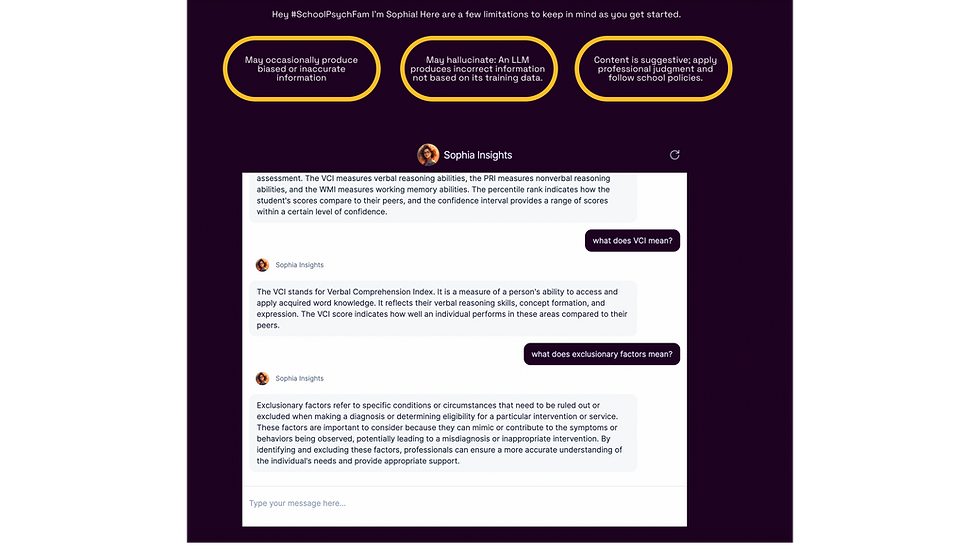
School psychologists spend significant time preparing for IEP meetings, eligibility determinations, and consultation conversations with teachers and administrators. Many practitioners use our AI assistant, Sophia, to prepare talking points, draft parent-friendly evaluation summaries, generate questions to explore before a meeting, and summarize lengthy records ahead of a staffing.
Sophia processes more than 87,000 questions per month from practitioners on the platform. Those questions span assessment interpretation, legal guidance, ethical considerations, and how to communicate complex findings to families in plain language. The platform serves as a thought partner for the full scope of the job rather than just functioning as a document tool.
3. Behavioral and Functional Assessment Support
When evaluating the best school psychology AI tools to assess student behavior, practitioners look for platforms that support functional behavior assessment documentation. School psychologists, behavior analysts, and special education staff use AI to organize behavioral observation data and write behavioral descriptions that connect to both the data and the student's strengths.
While AI leaves clinical determinations and actual observations to the practitioner, it helps organize what you have observed. It helps identify patterns and allows you to write with precision under time pressure.
4. Family Communication
Writing that parents can understand is a professional obligation and a legal requirement in many districts. Practitioners use AI to convert clinical report language into plain-language summaries, draft parent notification letters, and prepare communication templates for different evaluation types. The nearly 80 percent accessibility improvement we saw in the NPS survey is a direct result of this kind of use. Practitioners who have the right tools and the right amount of time to apply them produce writing that families can actually engage with.
5. Progress Monitoring and Data Summaries
School psychologists embedded in data teams and intervention support structures use AI to synthesize progress monitoring data, organize trends across students, and prepare summaries for problem-solving teams. This work has historically landed on school psychologists because someone has to do it, rather than because it requires clinical expertise. Artificial intelligence handles the synthesis efficiently so practitioners can focus on interpreting the findings instead of simply compiling them.
What to Look for in an AI Tool for School Psychology
If you are evaluating AI platforms as a practitioner or a district leader, you need to know which features actually matter. Here are the four criteria you should prioritize when looking at artificial intelligence school psychology 2026 tools.
FERPA Compliance
Any AI platform used in a school psychology context must be FERPA-compliant. Student data is legally protected, and the platform you use must have the legal and technical architecture to match those protections. School Psych AI is the only independently evaluated FERPA-compliant AI platform built specifically for school psychology.
Scope Beyond Documentation
You should ask whether the platform supports your full practice or only your reports. A report drafting tool saves time in one area, but a platform that supports your consultation work, data summaries, family communication, and professional learning is a different category of investment. That comprehensive support separates tools that help you write faster from tools that give you more time to practice.
Practitioner Control of Clinical Judgment
AI should support your thinking rather than replacing it. The right platform keeps the school psychologist in control of every clinical decision while handling structure and language work efficiently. If a tool positions itself as capable of making clinical determinations, that is a reason to be cautious.
Community and Ongoing Development
AI tools for a specialized field need to keep pace with how that field actually works. Look for a platform with an active practitioner community, a feedback loop that shapes product decisions, and a development team accountable to what practitioners need. School Psych AI has been built with input from a community of over 3,000 practitioners who have shaped every major product decision since the platform launched in 2023.
The Question Behind the Question
Earlier we discussed the question practitioners are asking about whether AI is actually useful for this work. The data from 725 colleagues confirms that it is, and it highlights a specific kind of usefulness we need to name clearly.
AI is useful for school psychology because it returns time that practitioners were spending on documentation and gives it back to the work that requires a human being. This work requires someone who knows these students, knows this community, and knows this field. AI built for school psychology is more than a report writer. It is how practitioners are protecting their capacity to do the work that actually matters.
If you are ready to see what that looks like in your own practice, start a free trial at www.schoolpsych.ai. If you are a district leader exploring AI support for your team, you can request a quote directly on our site.
School Psych AI gives you back the time you need to do the work you love.
Frequently Asked Questions
How are school psychologists using AI in report writing?
School psychologists use AI to draft report sections from assessment data, generate strength-based narrative language, and produce recommendations. Platforms like School Psych AI allow practitioners to build reports section by section while maintaining full clinical control of the final document.
Is AI appropriate for school psychologists to use?
Yes, when used appropriately. AI tools should support practitioner judgment, and the school psychologist remains responsible for all clinical decisions. Practitioners must confirm that any AI platform they use is FERPA-compliant before using it with student data.
What AI tools are available specifically for school psychologists?
School Psych AI is the leading platform built specifically for school psychologists and related service providers. It includes AI-assisted report writing, an AI assistant named Sophia, and over 50 specialized tools covering the full scope of school psychology practice.
How much time can AI save a school psychologist?
Based on 2026 survey data from 725 practitioners, school psychologists using School Psych AI save an average of four or more hours per week on report writing. Report writing time decreases by 40 to 60 percent for most users.
What is the NPS score for School Psych AI?
School Psych AI earned a Spring 2026 NPS of +53.2, placing it in the excellent band. This score reflects feedback from 725 practitioners surveyed in April 2026.
School Psych AI is more than a report writer. We exist to give practitioners back the time and mental space to do more of what they love.
Try today at www.schoolpsych.ai

It's encouraging to see survey data on how practitioners are actually using AI to cut down documentation time, though I'd be curious how many are also exploring an AI Video Tools Directory for creating training or psychoeducation materials.
Sharing each guess across four word boards changes how you approach a word puzzle. Quordle asks you to solve all four hidden words within one shared attempt limit. A guess can be valuable for the information it reveals even when it is unlikely to solve a board immediately.
I found the article really interesting, especially the point about reducing paperwork so psychologists can spend more time helping students. On the entertainment side, when I need a quick break after reading something work-related, I often play Subway Surfers for a few minutes—it’s simple, relaxing, and a fun way to clear my head.
I opened Block Blast after rearranging magnets on the refrigerator door. Moving shapes around in real life somehow put me in the mood for the game.