
🥳 School Psych AI Turns 3!

It’s hard to believe that School Psych AI turns 3 today.
If one thing has guided me as a practitioner, it is this: when I see a need, I try to do something about it.
That mindset has shaped a lot of my career. It has led me to create programs, write books, build resources, and try to solve problems I saw firsthand in schools. School Psych AI grew out of that same instinct.
School Psych AI Origin Story
When OpenAI released ChatGPT in November 2022, I was an early user.
I used it to organize my thoughts, reword things, and get ideas onto paper. Writing has never come naturally to me. I would much rather speak to a room of 500 people than sit down and write. But this technology helped me with something that had always been difficult for me.
That made me wonder: if this could help me, could it help school psychologists too?
I did not want to jump into something I did not understand, so I started learning. I took an AI course and became obsessed with understanding the technology, how large language models worked, what they could and could not do, and the ethical questions surrounding their use.
At the same time, I was traveling and speaking about strength-based practices and what our field could look like when we focused more on the whole child.
After those talks, I kept hearing the same thing:
“Doc, that sounds great, but my caseload is ridiculous.” Or, “How am I supposed to do that when most of my time is spent testing and writing reports?” I heard some version of that over and over. Then it clicked.
The same technology helping me could help practitioners spend less time on the tedious parts of the job and create more capacity for the work that requires their judgment, relationships, and expertise.
So, I went back to what has always guided me. I saw a need and decided to do something about it.
Sophia was born
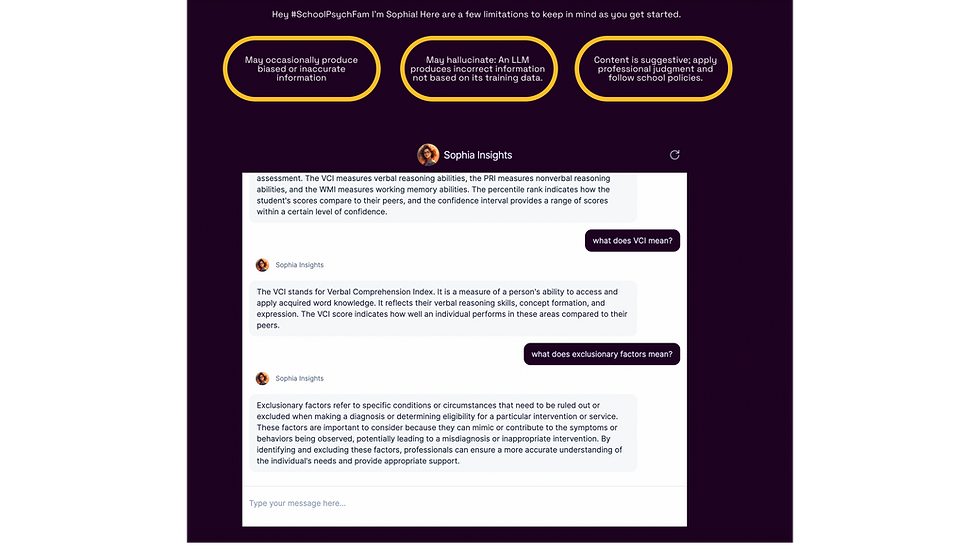
I built a chatbot and knowledge base with support around interventions, IEP goals, and report writing. Then I needed a name.
I named the chatbot Sophia because of my interest in Carl Jung and the idea of Sophia as a symbol of wisdom. I wanted her to be a thought partner, never the decision-maker. The practitioner would always remain responsible for the judgment, interpretation, and decisions that matter.

On September 28, 2023, School Psych AI and Sophia launched.
Within 72 hours, more than 1,000 school psychologists had signed up. Within weeks, that number passed 5,000. By the end of 2023, nearly 10,000 practitioners had joined.
The questions came just as fast as the growth.
Is my data safe? Is this ethical? Will this replace practitioners? Those questions were fair. Sometimes they were tough. But they helped shape the company.
They also pushed me to think much more seriously about what it would take to build this the right way. That eventually led to my CTO and co-founder, Eduard Grubman, coming on board, and together we took School Psych AI to the next level.
Growing up quickly
As more practitioners started using the platform, it became clear that useful AI tools were only part of the job.
We needed the privacy, security, and ethics infrastructure to support schools. We needed systems that districts could trust. We needed to build something that could hold up under the scrutiny that should come with using AI in education.
Over the next three years, we did that work.
School Psych AI earned FERPA certification through iKeepSafe. We expanded from three tools to more than 50. What started with individual practitioners grew into school systems of every size, from small departments with one practitioner to large urban districts and just about everything in between.
Internally, our team consisted mostly of practitioners, and we stayed lean. Massive shout-out to our team and to everyone who played a part across these three years to help shape the platform. The product changed dramatically too. We built tools for report writing, document editing, interventions, behavioral support, communication with families, progress monitoring, professional learning, and much more.
But the goal was never to simply add more features. The goal was to help practitioners do their work better.
We got things wrong too
The last three years have not been a straight line upward. We had bugs, reliability problems, and features we had to rebuild. We listened, fixed what needed fixing, and kept moving.
Building in public has also meant facing scrutiny and having people question my motives. And as a Black founder in this space, I am very aware of the opportunities I have been overlooked for, the difficulty accessing funding, and the challenges that come with building in rooms where very few people look like me. But I accept that part of the work too.
I know what we are building. I know why we are building it. I know who we are building for.
And I believe the vision I have for this field is worth pushing through every challenge that comes with it.
That does not mean pretending the challenges do not exist. It means deciding they are not going to determine what we are capable of building.

Three years later
Today, School Psych AI is approaching major revenue milestones with no private equity or outside funding.
I am proud of that, but here is what matters to me most. In our Spring 2026 survey of 725 practitioners, respondents reported spending 40 to 60% less time writing reports. Fifty-seven percent said they had expanded their work beyond documentation, and nearly 80% said their writing became clearer for families. That is what I care about.
We are actualizing what we set out to do. The idea was never simply to make report writing faster. The idea was to give practitioners more capacity to use the full range of their skills, spend more time with students and families, consult with teams, support interventions, and do the work that cannot be reduced to paperwork.
And it all started with seeing a need and deciding to do something about it.
The original idea has not changed
Three years later, the original idea is still the same: AI should not replace practitioners.
It should help give them more capacity to do the work only they can do.
The platform has changed. The technology has changed. The team has grown. What School Psych AI can do today looks very different from what we launched in 2023. But the reason we built it has stayed remarkably consistent.
Thank you to every practitioner who gave us a chance when we were brand new, everyone who challenged us, everyone who gave us honest feedback, and everyone who helped shape School Psych AI into what it is today.
Three years in, and we're just getting started!
Share a testimonial or encouragement in the comments below! Especially if you've been with us since the beginning or joined us at some point along for the ride, we'd love to hear from you!


Comments