
How School Psych AI Is Different From Other AI Report Writing Platforms


I am not against report writing. When done well, evaluations can help families find answers they have been searching for, put students on a path toward success, and provide insights that only a skilled practitioner can uncover through a comprehensive psychological evaluation.
What I oppose is report writing becoming the defining characteristic of school psychology, as if it represents the entirety of our professional identity. The issue is what happens when documentation becomes the ceiling of our practice. When that happens, we are reduced to a test-and-place role, limiting the broader impact we can have on students, families, and school communities.
That is the reason School Psych AI exists.
School Psych AI was built to help school psychologists, SLPs, and related service providers use their full skillset. We should be helping teams understand data, strengthen interventions, improve student support, communicate clearly with families, lead conversations about mental health, and make fair, thoughtful decisions for students.
Reports matter. Compliance matters. Clear documentation matters. But the future of school psychology should be bigger than paperwork.
Most AI report writing platforms start with the same promise: help practitioners finish reports faster. We started there too. Being first to market almost three years ago taught us that speed helps, but speed alone does not solve the deeper practice problem.
The challenge is capturing your findings, why it matters, what data supports it, what should be stated cautiously, what should be left out, and how to explain the finding in a way that a parent, teacher, or team member can actually use, while preserving your clinical judment and expertise as a practitioner.
School Psych AI supports the full workflow behind the report: the thinking, writing, communication, and follow-through that students and teams need.
The Difference in Plain Language
Category | Competitor Framing | School Psych AI Framing |
Core job | Help users produce reports faster | Help practitioners think, write, revise, communicate, and act across the full workflow |
Workflow | Often built around a report-generation sequence | Flexible by design so practitioners can start with the data they have and keep building as new information comes in |
Scope | Mostly report writing and assessment documentation | 50+ tools across evaluation, IEPs, FBAs, BIPs, observations, progress monitoring, family communication, data analysis, and support planning |
Practice philosophy | Faster reports | Expanded scope of practice |
Pricing | Some tools use pay-per-report or report limits | Fixed-price value with no pay-per-report positioning |
Support | Product support | Implementation support, trainings, workshops, office hours, district PD, and NASP-approved CPDs |
Voice | Product company serving clinicians | Built by a school psychologist and shaped with a practitioner community |
Accessibility | Parent-friendly language may be included | Accessibility is a platform-wide principle, including parent-friendly language, readability support, strength-based language, translation, and family communication tools |
Cultural and linguistic review | May be present in some form, but not always central | Explicit tools and workflows for cultural and linguistic considerations, equity review, and fair interpretation |
Designed for the Way Practitioners Actually Work
Real practice does not happen in a neat, linear sequence.
Sometimes you have the score report first. Sometimes you have teacher input before parent input. Sometimes you need to check whether your recommendations actually connect to the data. Sometimes you are reviewing a draft evaluation and realizing the report answered the test results but missed the referral concern.
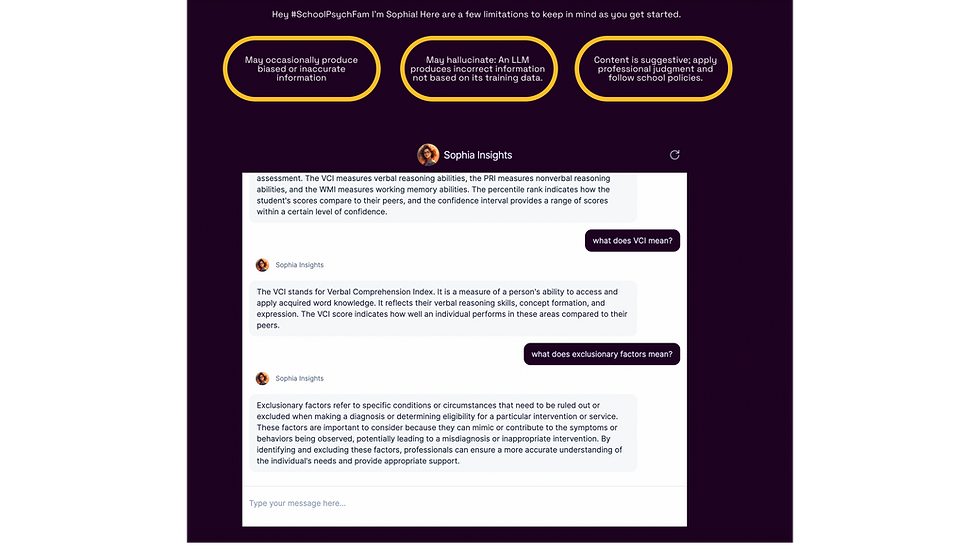
School Psych AI gives practitioners flexibility to start with the information they have and keep building as new information comes in. You can upload a score report, draft section, observation notes, rating scale, IEP, FBA, BIP, progress monitoring file, district guidance document, or meeting notes. From there, Sophia can help you ask better questions, identify gaps, strengthen reasoning, and produce clearer next steps.
The tool should fit the work instead of forcing the work to fit the tool.
Built by Someone Who Has Done the Work
School Psych AI was built by a school psychologist who understands the work from the inside.
I have worked across school levels, district settings, crisis teams, MTSS teams, PBIS work, 504 coordination, counseling groups, restorative practices, and central office leadership. I have also written reports at night and on weekends, which means I know the pressure from both sides: the compliance responsibility and the larger work students still need us to do.
That lived experience shaped the platform. School Psych AI was built for practitioners who want to write better reports and lead better work in schools.
Built for the Work Behind the Report
School Psych AI includes more than 50 tools built for school-based practice. The platform supports school psychologists, SLPs, special educators, social workers, counselors, BCBAs, educational diagnosticians, OTs, PTs, school nurses, and mental health clinicians who support students in schools.
Practitioners can use School Psych AI for psychoeducational report writing, IEP goals, present levels, recommendations, accommodations, behavioral observations, FBAs, BIPs, social development histories, counseling notes, therapy session planning, progress monitoring, check-in/check-out data, family letters, readability support, parent-friendly explanations, and translated summaries.
That range matters because student support is team-based. A school psychologist may write the evaluation, an SLP may support communication needs, a special educator may write goals, a counselor may provide services, a BCBA may support behavior planning, and a school nurse may help with health-related supports.
Expanded Scope of Practice Is the Mission
The mission of School Psych AI is expanded scope of practice.
When practitioners get time back, they can use more of their training. They can consult with teachers, support families, analyze data, improve interventions, lead problem-solving conversations, support mental health, and help teams make stronger decisions for students.
That is why School Psych AI includes tools for culture and climate data, discipline patterns, intervention review, equity checks, parent communication, meeting preparation, and support planning. These are not side features. They are part of the larger role practitioners can play when documentation does not consume every available hour.
Fair, Clear, and Family-Friendly by Design
School Psych AI helps practitioners slow down where careful review matters.
The Cultural Linguistic Considerations tool helps users think through culture, language, schooling history, opportunity to learn, instruction, attendance, trauma, mobility, and intervention access before drawing conclusions about a student.
That matters because ethical AI use in evaluation should help practitioners ask better questions and connect decisions back to data.
School Psych AI also helps practitioners make technical information clearer, more parent-friendly, more strength-based, easier to read, and easier to translate. Families deserve reports they can understand, and teams need findings they can act on.
Clear writing is part of good practice.
Built With Practitioners, Not Dropped Onto Them
School Psych AI has been shaped by practitioner feedback from the beginning.
Users tell us what works, what needs to change, and what tools would actually help them do the job. We listen, adjust, and keep improving. That matters because AI tools in education cannot be built in a vacuum. The people closest to the work should shape the tools being used in the work.
School Psych AI has spent more than 2.5 years learning alongside practitioners. A company can copy features, but it cannot instantly copy the trust, feedback, practitioner insight, and lessons learned from thousands of real use cases.
Strong Support, Better Pricing, and Real Professional Learning
Districts and practitioners need more than software access.
School Psych AI provides customer support, trainings, workshops, office hours, district professional development, implementation support, and NASP-approved CPDs. Responsible AI use requires judgment, practice, and shared expectations.
Pricing matters too. Some AI report writing tools charge by report, cap usage, or create pricing structures where the cost rises as practitioners use the tool more. School Psych AI is built around strong fixed-price value and no pay-per-report positioning.
Practitioners should be able to use the platform for report writing, revisions, meeting preparation, recommendations, parent communication, progress monitoring, intervention review, data analysis, and support planning without feeling like every use needs a budget calculation.
Trust and Student Privacy
AI in schools requires trust.
School Psych AI is FERPA-certified through an independent evaluation by iKeepSafe. Student privacy, ethical use, and responsible data practices have been part of the foundation from the beginning.
Districts should ask hard questions about any AI tool that touches student information. Claims are easy. Independent review gives districts and practitioners a stronger basis for trust.
What Practitioners Are Telling Us
Practitioners are using School Psych AI as part of their regular work.
In the Spring 2026 survey, 94% of practitioners reported using School Psych AI daily or weekly. Practitioners reported a 40 to 60 percent reduction in report writing time. Among respondents who answered the time-savings question, the average time saved was 3.4 hours per week, with more than 1 in 4 reporting 5 or more hours saved each week.
The same survey found that 57% of practitioners reported expanding their scope of practice beyond documentation and report writing. Eight in 10 practitioners reported that School Psych AI improved the accessibility of their writing for families.
Those findings connect directly to the mission. School Psych AI helps practitioners write reports, communicate clearly, think more carefully, and create more space for the parts of the role that require professional presence and judgment.
The Bottom Line
PAR AI, Pearson, SageReport, LilyAssist, and other platforms are addressing the report-writing burden in different ways. That work has value, and practitioners should compare tools carefully.
School Psych AI offers a different kind of fit.
It was built by a school psychologist who has done the work. It was shaped with a practitioner community. It supports the full workflow behind the report. It includes more than 50 tools across school-based practice. It prioritizes accessibility, culturally responsive decision-making, professional learning, flexible use, strong value, human support, and responsible data practices.
Most importantly, School Psych AI is guided by a clear belief about the field: school psychologists, SLPs, and related service providers should be leaders in schools, not professionals whose impact gets trapped inside paperwork.
Next Step
If you are comparing AI report writing platforms, ask a better question than, "Which one writes reports the fastest?"
Ask which platform helps your team practice better. Ask which platform fits the way practitioners actually work. Ask which platform supports the full scope of school-based practice, protects student data, improves family communication, supports professional learning, and gives practitioners practical room to lead.
Then choose the platform that helps your team do the work behind the report.

In Buckshot Roulette, I make a choice that seems ordinary at first, then notice several turns later that it created a useful opportunity. Those delayed payoffs are incredibly satisfying.