
From Curiosity to Confidence: What the Data Actually Shows

By Dr. Byron M.L. McClure

"I do not want to go back to doing my job without Sophia!"
One of our core values and guiding ethical principles at SPAI is transparency. This article will share the findings from our most recent PD.
Before the PD session started, most attendees were still sitting with uncertainty. Some were curious. Some were cautious. Some were actively worried. Of the practitioners who answered the pre-session poll, only 6% said they felt very confident using AI in their work. Sixty-nine percent said they felt only somewhat confident or not confident at all.
By the time the session ended, that picture had completely changed.
Among 52 post-session responses, 87% of attendees said they felt moderately or very confident using AI. Not a single attendee said they were unprepared to use it. The share of people in the lowest confidence categories dropped from 69% to 13.5%.
Those numbers matter. But what matters more is what they point to: a session that met people where they were and moved them somewhere new.
100% of respondents rated the content as very relevant or extremely relevant to their practice. Every single person in the room said the content applied to their work. That is the hardest score to earn. Relevance is personal. It means the session connected to real responsibilities, real caseloads, and real daily decisions.
And when the session ended, 0% of attendees said they felt unprepared to use AI in their work.

What the Numbers Say About the Session
The session was built around four priorities: practical application, ethical guardrails, prompt improvement, and live use cases. That structure shows up directly in the results.
The confidence shift is the clearest evidence. Before the session, only 31% of attendees felt moderately or very confident using AI. After the session, that number rose to 87%. The share of attendees in the lowest confidence categories dropped from 69% to 13.5% in a single session.
That kind of movement does not happen by accident. It happens when a session is designed around what practitioners actually need, not what a general AI audience might want to hear.
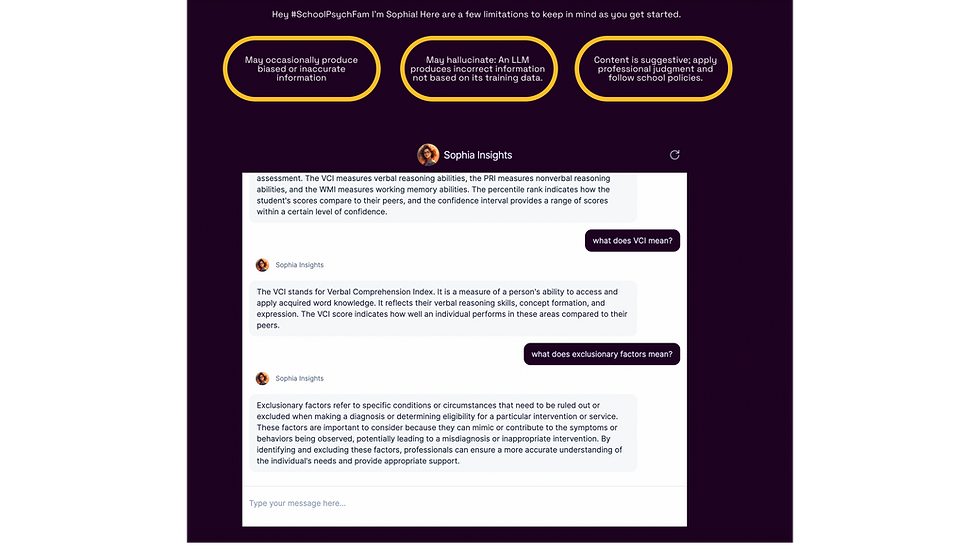
The session also did something harder to quantify. It reduced intimidation while preserving professional judgment. Participants openly discussed limitations, hallucinations, district policy concerns, and prompting quality. That combination, increased confidence alongside honest acknowledgment of limitations, is exactly what ethical AI training for school psychologists should produce.

What Practitioners Actually Walked Away With
The post-session comments were specific. That specificity matters. People did not leave saying they found the session interesting or that they learned something new about AI in general. They left naming tools and use cases they planned to try that week.
Attendees pointed to report summarizing, readability for family communication, FBA and BIP development, IEP goal writing, observation support, recommendation generation, and rewriting emails in tense situations. Several attendees mentioned that the live demonstrations were what made the difference. Seeing the tools and prompts used in real time gave people a concrete reference point they could return to on their own.
There is also a second layer of impact that is easy to miss in the numbers. This session did not just help practitioners work faster. It helped some of them communicate more clearly with families.
One attendee shared that a parent cried after receiving a report because, for the first time, she said she actually understood it.
That outcome points beyond efficiency. It points to access.
"One parent actually cried when I gave it to her because she said she never understood the reports before." ~ School Psychologist, Midland TX

Voices From the Room
The session brought together newer users and long-time Sophia users alike. Both groups left with something. Here is what they said...
"Sophia has renewed my passion for school psychology." ~ School Psychologist, Southeast Ohio
"These folks can really fix problems wonderfully and rapidly." ~ School Psychologist, Cornish ME
"I told Byron yesterday, 90% reduction in paperwork for FBA." ~Practitioner
"The presentation was exceptionally clear and easy to follow. I gained several valuable takeaways, especially around readability for families and staff." ~ School Psychologist, St. Louis MO

What This Means for the Field
School psychologists carry heavy caseloads. Documentation pressure is real. Burnout is real. The gap between the work practitioners want to do and the time they have to do it is real.
What this session showed is that AI, used well, can close some of that gap. Not by replacing clinical judgment. By speeding up the parts of the job that drain time without adding clinical value, so practitioners can spend more of their energy on the work that actually requires them.
The feedback also showed something important about how that shift happens. People do not move from uncertain to confident by reading about AI. They move when they see it in action, practice with it directly, and understand both what it can do and where its limits are.
That is the design philosophy behind every School Psych AI professional development session. Start with what practitioners need. Stay grounded in real school psychology work. Build confidence through clarity and practice, not hype.
The data from April 3rd confirms that the approach is working.
Ready to take your AI skills to the next level?
Join us for our next session:
When: Wednesday, July 8th at 1:15 PM CST
Session Title: Next-Level Game Plan: Advanced AI for School Psychologists with Dr. Byron McClure and Rachele Teson.
Brief Session Description: This session goes beyond introductory AI use and focuses on advanced strategies school psychologists can use to work smarter, not harder.
Ready to see what Sophia can do? Join thousands of school psychologists using AI to work faster, write better, and serve families more clearly. Learn more at schoolpsych.ai

The jump from 6% to 87% confidence after one PD session really shows how much hands-on training matters for school psychs. I've been thinking about the same thing on the tech side, like how clear AI video generation API pricing would make it easier for districts to budget for these tools before staff even sit down for training.
Combining fast-paced action with humorous physics, Ragdoll Hit gives players an entertaining fighting experience where quick reactions, accurate movements, and well-timed attacks can make every battle feel exciting and unpredictable.